

A board election can lose credibility before a single vote is cast. The owners association election verification process starts with a dependable owner-and-unit register, so eligibility decisions are consistent and discrepancies can be addressed before voting opens.
Unclear records, owner-unit mismatches, and questions about who may act on an owner’s behalf can create uncertainty for voters and administrators alike. A documented approach helps the association apply its governing documents and applicable requirements consistently, while recording decisions without circulating unnecessary personal information.
This practical four-step guide explains how to assemble and check the eligibility list, resolve exceptions transparently, and preserve a clear verification record. ARW Trading supports digital board elections for owners associations in Oman by verifying eligible owners and units, maintaining an audit trail, and producing a certified election report. These steps provide a traceable foundation for voting and for reporting the outcome.
Key Takeaways
- Use the owners association election verification process to establish eligibility before voting opens, rather than resolving basic record questions during the election.
- Compare owner identity, the relevant unit, and the association’s governing eligibility basis. Keep source records separate from the approved voter register.
- Route missing or conflicting records and representation cases through a consistent review process. Document decisions and handle personal information carefully.
- Follow four defined stages to set criteria, review records, resolve exceptions, and finalise the verified register before moving to voting activities.
- ARW Trading’s digital election process verifies eligible owners and units, maintains an audit trail, and produces a certified election report.
Why Owners Association Election Verification Starts Before Voting
An election register is dependable only when the association establishes who is eligible to vote, and the basis for each decision, before ballots are issued. The owners association election verification process checks each proposed voter against the eligibility criteria in the association’s governing documents and applicable Oman requirements. Those sources should guide the review. Administrators should not replace stated criteria with assumptions or informal precedent.
Timing matters because voting creates additional administrative work. If eligibility questions surface only after ballots are distributed, administrators may have to pause and investigate while owners are already participating. Reviewing records beforehand gives the association time to identify unclear entries, apply a consistent approach, and provide a defined route for discrepancies. This reduces avoidable uncertainty, although it cannot guarantee that no dispute will arise.
Verification has a specific boundary: it establishes the voter register. It does not determine how anyone votes, count ballots, or certify the election result. Keeping these functions distinct makes it easier to explain what was checked at each stage. General background on association governance and elected boards is available in Homeowner Association Governance and Elections. The association’s own governing basis and applicable Oman requirements remain central to its eligibility criteria.
What does election verification establish?
For each proposed voter, the review links an owner record to the relevant property unit, then assesses eligibility against the applicable basis. A match supports inclusion. A gap or conflict calls for review, not an improvised decision. Verification concerns a person’s eligibility to participate, not their preference or the eventual result.
Voter eligibility verification confirms whether a person qualifies to vote under the applicable association criteria; ballot tabulation records and counts votes after they are cast.
Why should the eligible list be settled in advance?
A settled list gives owners a clear point at which to raise discrepancies and gives administrators time to consider them consistently. The association can record an issue, review the relevant information, and document its decision before voting begins, rather than handling similar cases differently under election-day pressure.
For example, a proposed voter’s owner record may not align with the unit information. If the mismatch is identified in advance, the administrator can refer it through the association’s established review route and update the register if appropriate. The example does not determine eligibility. The outcome depends on the governing basis and applicable requirements.
Once the register is finalised, administrators have a stable reference for voter access when voting opens. Any later correction should follow a documented process so the reason for the change is traceable. This keeps the eligibility list separate from records of ballots and election results.
What Owners Association Election Verification Needs to Check
A useful review connects three things: the proposed voter’s identity, the property unit associated with that person, and the eligibility basis set out in the association’s governing documents and applicable Oman requirements. Assess these elements together. A name in a general contact list, for example, does not by itself establish which unit it relates to or whether the person meets the relevant criteria.
Before finalising the register, identify which records support each check and keep them separate from the approved voter list. Source records provide evidence for review; the final register records the eligibility decision and the information needed to administer voting. This separation helps prevent an unreviewed spreadsheet or an old contact list from being treated as the authoritative result.
Match each owner to the correct property unit
Use the association’s available ownership and unit records to make a traceable match. Compare identifying details and unit references across the records held for the association. Note whether they agree and whether the information appears current. Do not treat a particular record as legally sufficient by default. Applicable Oman requirements and the association’s governing documents determine what supports the decision.
Set aside exceptions rather than resolving them through guesswork. Examples include a missing owner record, a unit reference that differs between records, information that appears outdated, or more than one person associated with a unit. Record what does not align and route it for review under a consistent procedure. If the available information does not resolve the issue, document its status rather than silently treating the entry as a confirmed match.
Set and document eligibility criteria
Write down the criteria before assessing individual cases. Use the applicable governing documents and requirements as the source, then apply each criterion in the same way to comparable records. The Election Security and Integrity Best Practices from the EAC provide general public-election context on maintaining orderly processes. For an owners association in Oman, the association’s own governing basis and applicable local requirements must guide eligibility decisions.
A concise decision record can capture:
- The owner and unit reference reviewed.
- The eligibility criterion applied and its source.
- The outcome, such as included, excluded, or referred for clarification.
- A short reason for the decision and any follow-up required.
Do not infer that service-charge arrears affect voting rights unless an applicable governing basis says so. Avoid adding informal conditions simply because they seem administratively convenient. Consistent criteria make decisions easier to explain and review. Separating source material from the approved register also limits unnecessary circulation of personal details. This disciplined record review is part of ARW Trading’s digital board elections for owners associations, which verify eligible owners and units and maintain an audit trail.
How to Handle Owner-Unit Mismatches, Representatives, and Privacy
A record that does not align should trigger a defined review, not an improvised eligibility decision. Apply the same route to comparable cases, document the outcome, and keep disputed entries separate from confirmed matches until they are resolved. This gives administrators a consistent way to handle exceptions without assuming they all have the same cause or outcome.
| Case | Review approach | Record to keep |
|---|---|---|
| Clear owner-unit match | Compare the owner and unit details with the association’s available records and apply the established eligibility criteria. | Decision and basis for inclusion. |
| Missing record | Log what is absent and request or locate the information through the association’s defined review route. | Missing item, follow-up, and status. |
| Conflicting records | Identify the inconsistent details, review the relevant records, and refer the case for an impartial decision under the association’s governance process. | Records considered, decision, and reason. |
| Representative or proxy | Assess the claimed authority according to applicable governing documents and requirements; do not assume a representative may vote. | Basis reviewed and determination. |
Resolve discrepancies through a consistent review path
For each exception, log the discrepancy, records reviewed, decision, reason, and decision date. Set a correction window before finalising the eligible list, and explain how an owner can raise a concern within it. Establish the window for the election process rather than treating it as a universal deadline. If a case remains unresolved, escalate it through the association’s applicable governance process and record its status.
This audit trail makes it possible to explain how similar cases were treated without exposing the full source file to everyone involved. It also helps administrators distinguish a corrected record from an unresolved question. Neither should be hidden through an undocumented register edit.
Treat representatives and personal information carefully
Joint ownership, proxy voting, and representation can raise different eligibility questions. Their treatment depends on the association’s governing documents and applicable requirements. Record the rule relied on rather than assuming every co-owner or representative has the same voting authority. The review should focus on whether the person is eligible to act, not on their likely voting preference.
Collect and retain only the information needed to assess eligibility and document the decision. Keep owner and unit verification records separate from ballot choices, and limit access to personal details to those who need them to administer the process. This separation is a practical privacy measure. It is not proof of ballot anonymity unless the voting arrangements establish that outcome.
A documented owners association election verification process gives clear matches, exceptions, and representation cases a consistent route. It supports accountable decisions while leaving ballot handling and the election result to their separate procedures.
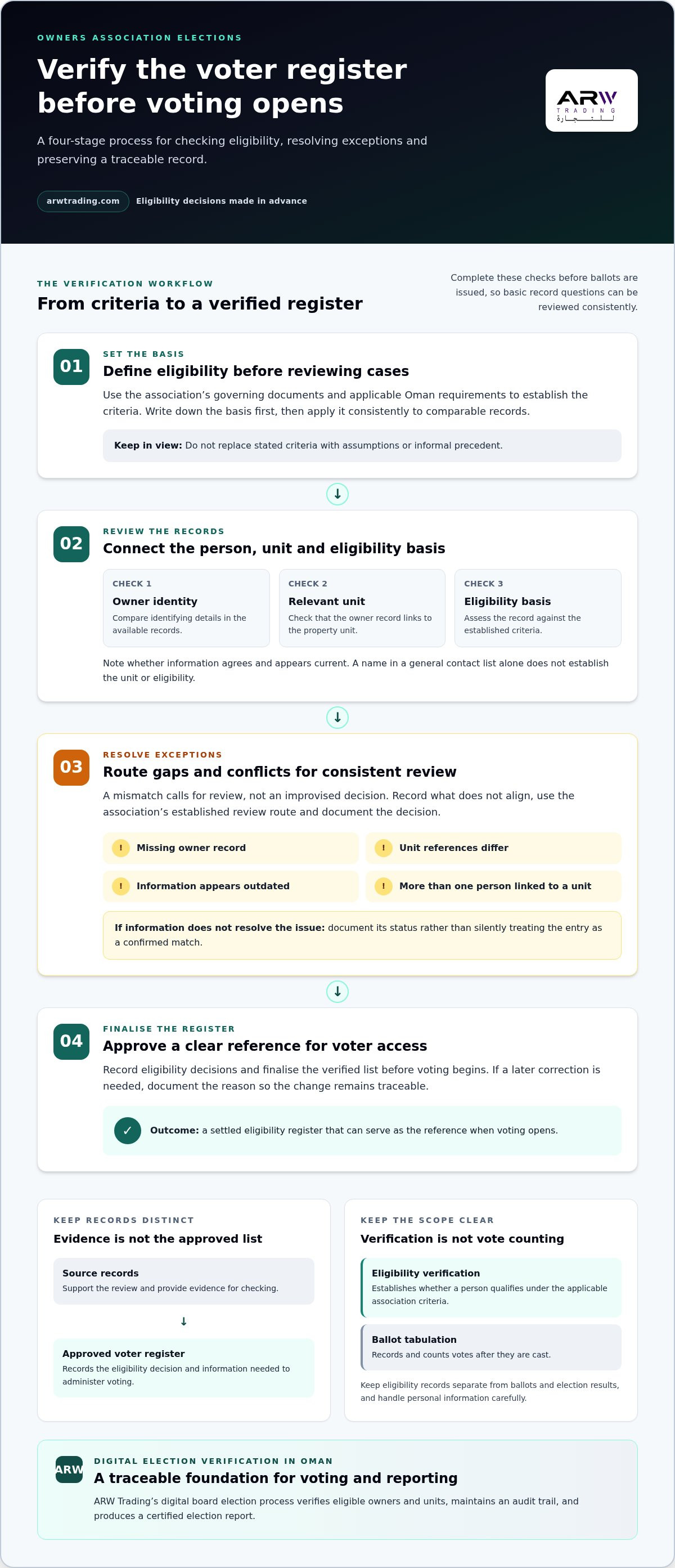
A Four-Step Owners Association Election Verification Process
A practical owners association election verification process moves from agreed criteria to a dated, reviewed register. Assign responsibility for each stage and retain a record of the work completed. The sequence below covers eligibility verification only. Candidate nominations, ballot issuance, vote counting, and result certification belong to separate election stages.
Set the timetable and review route in line with the association’s governing documents and applicable Oman requirements. Do not create eligibility rules or deadlines by assumption.
- Set and record the eligibility criteria. Before reviewing individual names, the person coordinating verification identifies the relevant criteria in the applicable governing documents and requirements. Record the source for each criterion and the date it was reviewed. The output is a written criteria sheet to guide every later decision. This helps prevent administrators from changing the basis midway through the review to fit a particular case.
- Reconcile owner and unit records. An assigned reviewer compares the association’s available owner and property-unit information against the agreed criteria. Keep original source records unchanged; record discrepancies separately rather than editing source information to force a match. The output is a working review list that distinguishes clear matches from missing, conflicting, or outdated information and identifies cases requiring follow-up.
- Review corrections and exceptions. The designated decision-maker considers corrections through the same documented route for each case. Record the information reviewed, the criterion applied, the decision, and its date. Give owners a clear way to raise discrepancies and a correction period set in accordance with applicable rules. The output is an exception log showing resolved cases and any matter still awaiting determination.
- Approve and date the verified register. Once the review is complete, the person authorised under the association’s process confirms the final list and records its approval date. Before voting opens, communicate the correction route and relevant next steps in line with the governing documents and applicable requirements. The output is a controlled final register, separate from working files and ballot records.
Keep the stages distinct. A verified register establishes who is eligible under the criteria; it does not nominate candidates, issue ballots, count votes, or certify an outcome. If an exception remains unresolved, record its status and follow the applicable governance process rather than treating an unreviewed entry as settled.
ARW Trading’s digital board election process verifies eligible owners and units, maintains an audit trail, and produces a certified election report. Arrange documented digital election verification for an owners association election.
How ARW Trading Documents Digital Election Verification in Oman
For an owners association in Oman, verification is one defined part of a broader election process. ARW Trading manages online board elections and verifies eligible owners and units. Its process maintains an audit trail and produces a certified election report, linking the eligibility review to a documented election record without treating verification, ballot handling, and outcome reporting as the same task.
This distinction matters. The verified register establishes which owners and units meet the applicable eligibility basis. Election administration follows that review, while the report documents the election outcome. Each has a different purpose. Keeping those boundaries clear helps the association understand what the eligibility check establishes and what the final report records.
From verified eligibility to a documented election record
After eligibility has been reviewed, the approved owner-unit register provides the basis for the next election administration stage. It is not a record of how owners voted. ARW Trading’s audit trail supports traceability by maintaining a record of election-related activity. This does not imply technical safeguards or ballot secrecy features beyond the stated scope.
The certified election report is separate from the register and the audit trail. The register concerns eligibility; ballot handling concerns participation in the vote; the report records the election result. Keeping these records conceptually distinct makes it easier to identify what each document supports and avoids suggesting that an eligibility check alone establishes the outcome.
For association administrators, this separation also supports clear communication. Owners can understand that verification addresses who is eligible, while later election steps address voting and reporting. The owners association election verification process should therefore be documented as a preparatory governance task, not as a substitute for the rest of the election procedure.
What owners associations can prepare before starting
Preparation helps the eligibility review proceed from the association’s actual records and rules. Before starting, administrators can organise materials that explain owner-unit relationships and the criteria the association will apply. This does not determine eligibility in advance. It gives the review a consistent reference point and helps identify gaps for follow-up.
- Gather the current ownership and unit information available to the association, keeping source records distinct from working review notes.
- Identify governing documents and internal procedures that address eligibility, corrections, and representation questions.
- Note known record gaps or inconsistencies so they can be referred through a documented review route.
- Set out how owners can raise a correction and how the association will communicate relevant next steps.
These preparations give administrators a clear starting point while leaving specific eligibility decisions to the applicable documents and requirements. They also help keep personal information focused on what is needed for verification and process records.
Associations planning a documented online election can use ARW Trading’s digital board election support. The process brings owner and unit verification, an audit trail, and a certified election report into a traceable election workflow.
Set the Next Election Up for a Clear Start
Before the next election cycle begins, decide who will coordinate eligibility review, where decisions will be recorded, and how owners can raise a correction. Agreeing on these administrative points early gives the association a practical starting framework, while keeping the eligibility basis anchored to its governing documents and applicable requirements.
The owners association election verification process is most useful when it becomes part of routine election preparation rather than a last-minute records exercise. A clear review plan helps administrators approach the work consistently and gives owners a defined way to participate in correcting relevant information.
For associations planning an online board election in Oman, ARW Trading provides digital election support with documented verification and reporting. Explore ARW Trading’s digital board election service to consider how a structured process can support your association’s next election.
With preparation in place, your association can move forward with a clearer, more accountable basis for its election.
Frequently Asked Questions
Is an online owners association election valid in Oman?
Its validity depends on the association’s governing documents and applicable requirements in force when the election takes place. Before selecting an online method, compare the planned procedure with the association’s approved governance framework, including how eligibility and voting are handled. Avoid importing rules from another country. If the framework does not clearly address online voting, resolve that question through the association’s appropriate governance process before setting the election schedule.
Can a tenant vote in an owners association election?
Residence alone does not establish voting eligibility. The applicable governing documents and requirements determine whether an owner or an authorised representative may vote. For example, a tenant who manages day-to-day matters for an owner should not be added to the voter list solely on that basis. Apply the same standard to comparable cases, and resolve unclear authority through the association’s governance process before voting opens.
How do you verify who owns a unit in an owners association election?
Compare the ownership and unit records available to the association with the relevant eligibility criteria. In the owners association election verification process, a spelling difference or a unit reference that does not match can be flagged for review rather than treated as proof of ownership or ineligibility. Record the discrepancy and follow the association’s correction route. Which records establish ownership depends on applicable documents and Oman requirements.
Can one owner vote for more than one unit?
That depends on the rules governing the association and the election. An owner associated with several units should not automatically be assigned several votes, or a particular voting weight, without an established basis. Before ballots are issued, determine how the approved method treats each eligible unit and apply that method consistently. Record the relevant owner-unit relationships so administrators can address questions about the register without guessing at voting rights.
What happens if an owner’s name is missing from the voter list?
The owner should use the correction route communicated by the association and raise the omission before the applicable cutoff. Administrators can compare the information submitted with the relevant records, document the decision, and handle similar cases by the same standard. For example, a spelling variation may require review rather than immediate exclusion. The correction deadline must come from the association’s governing documents and applicable requirements, not an assumed general timeframe.
Should owner identity be linked to an individual ballot?
Eligibility checks establish who may participate, while ballot procedures determine how votes are handled. Whether voter identity is connected to a ballot, and whether choices are confidential, depends on the governing rules and election arrangements. Explain those arrangements accurately before voting begins. Limit personal information to what is needed for eligibility and administration, and don’t describe ballots as anonymous unless the process and applicable rules support that claim.
What should an owners association election verification record contain?
A practical record can identify the criteria applied, the register reviewed, exceptions considered, and decisions made, along with when the list was approved and by whom where applicable. For instance, an unresolved discrepancy should remain distinguishable from a resolved correction. Access and retention should follow the association’s governing documents and applicable requirements. Avoid adopting a fixed retention period or circulating personal records more widely than election administration requires.