

A digital ballot alone doesn’t make an election credible. For an Owners Association in Oman, digital board elections must also verify who is eligible to vote, protect the integrity of the process, and create a clear record of the outcome. This guide to digital board elections Oman focuses on those practical governance requirements, not just the software.
Online voting can be fair, accessible, and properly documented when the process is managed carefully, from confirming eligible owners and units to recording the proceedings and reporting the result. Digital and paper-based voting each have practical considerations. The right approach depends on the Association’s governing arrangements and participation needs.
Here, you’ll learn the key stages of a digital election, how to assess voting methods, and what accountable record-keeping involves. ARW Trading manages digital board elections for Owners Associations in Oman by verifying eligible owners and units, maintaining an audit trail, and producing a certified election report. These steps make the process traceable and the outcome easier to document.
Key Takeaways
- Understand why a digital board election is a governance process, not simply an online ballot.
- See how digital board elections Oman can progress from setting the election parameters to recording results.
- Compare online and paper voting by considering access, identity checks, record keeping, and result documentation.
- Use a readiness checklist to clarify responsibilities for owner records, communications, voting access, and oversight.
- Learn how aligning the process with the Association’s governing documents supports orderly, accountable administration.
Digital board elections in Oman: what they mean for Owners Associations
A digital board election is a structured online process for recording votes from eligible Owners Association members and documenting the result. It involves more than displaying a ballot on a screen. The Association needs to define the election, maintain reliable eligibility records, give clear instructions, and keep a traceable account of how votes were handled.
For an Owners Association, board elections determine who will carry out governance responsibilities on behalf of the community. An orderly process helps owners understand how to participate and gives the Association a record of its decisions. If questions arise later, documented steps and results can help explain what took place. Digital tools can support record keeping, but accountability depends on how the election is planned and administered.
How Owners Association elections differ from public or chamber voting
An Owners Association election is specific to that Association’s eligible owners, board, and governing arrangements. Oman’s wider use of electronic voting, including the Intikhab application for public elections and preparations reported for Oman Chamber of Commerce and Industry elections, provides context. Those examples do not set the rules for an Association election. The Association’s governing documents and applicable requirements determine its process.
In practice, the Association needs to establish its electorate from its own owner and unit records. A public or chamber voting model cannot answer questions about who may vote in the Association or how its board is elected. Electronic voting systems can take different forms, as outlined in this Electronic Voting Overview. The appropriate design is the one that fits the Association’s governance framework and supports a clear record.
What a digital election is designed to achieve
A credible digital process puts eligibility, participation, and record keeping in a clear sequence. Before voting opens, the Association needs to establish who is eligible under its governing documents and what the election covers. Owners then need clear instructions and a defined way to participate. After voting, the outcome should be recorded so it can be understood and reviewed.
Digital administration does not, by itself, make an election fair or reliable. The Association still needs to check whether owner records are accurate, explain how participants can access the process, and assign responsibility for oversight. Clear documentation links those decisions to the result, rather than leaving a ballot count without context.
- Define the election: Identify the board decision or positions being voted on, following the Association’s governing documents.
- Confirm the electorate: Use the relevant owner and unit records to establish eligibility.
- Document the outcome: Keep a clear record of the process and result for accountable administration.
For Owners Associations considering digital board elections Oman, the key question is not simply whether voting can take place online. The process should reflect the Association’s governing arrangements and leave a clear, reviewable record from eligibility through to the result.
How an Oman Owners Association digital election moves from eligibility to results
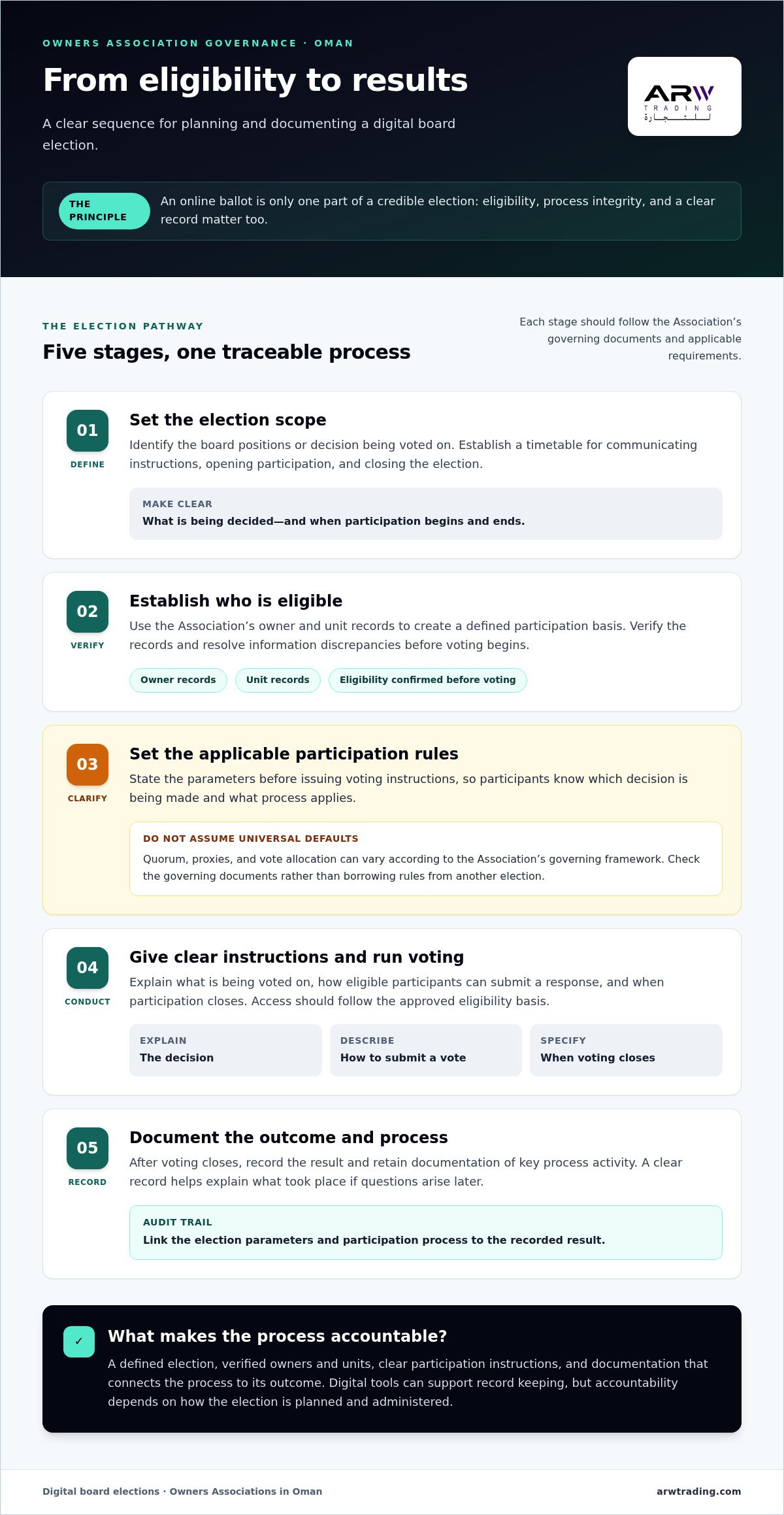
A well-managed digital election follows a clear sequence: define its scope, establish who is eligible, conduct voting, and document the outcome. Each stage should reflect the Association’s governing documents and applicable requirements. Don’t assume a particular quorum, proxy arrangement, or voting method without a basis in those documents.
For Owners Associations planning digital board elections Oman, preparation matters as much as the online ballot. Clear parameters help owners understand what is being decided, who may participate, and how the result will be recorded.
Set the election scope and participation basis
Start by identifying the board positions or decision covered. Set a timetable for communicating instructions, opening participation, and closing the election. These details should follow the Association’s governing documents and applicable requirements, not be borrowed from another type of election.
Next, establish the eligible-owner and unit list using the Association’s records. Verifying owners and units gives the election a defined participation basis and helps identify record discrepancies before voting begins. Resolve any information questions during preparation so eligibility is clear before the election is underway.
Rules for matters such as quorum, proxies, and vote allocation can vary according to the Association’s governing framework. Don’t treat them as universal defaults. Set out the applicable parameters before issuing voting instructions, so participants know which decision is being made and what process applies.
Conduct voting and document the outcome
Once the scope and eligibility are established, give eligible participants clear instructions and an organized way to submit their votes during the stated voting period. Access should follow the approved eligibility basis. Explain what is being voted on, how to submit a response, and when participation closes. Clear communication supports an orderly process, although digital voting alone does not guarantee fairness.
After voting closes, record the outcome and retain documentation of key process activity. An audit trail links the defined election parameters and participation process to the reported result. This record is useful if the Association needs to review how the election was administered or maintain a clear account of its decision.
- Define: Set the election scope and timetable in line with the governing documents and applicable requirements.
- Verify: Establish the eligible owners and units from Association records.
- Conduct: Communicate voting instructions and organize ballot access for eligible participants.
- Document: Record the result and retain a traceable account of the process.
ARW Trading manages this process for Owners Associations in Oman by verifying eligible owners and units, maintaining an audit trail, and producing a certified election report. Explore ARW Trading’s digital election service for an overview of this managed approach.
Online vs paper voting: assess trust, access, and accountability
Choosing between online and paper voting is a governance decision, not simply a choice between modern and traditional methods. Either format can support an orderly election if the Association defines participation, follows its governing documents, and keeps adequate records. Digital voting does not guarantee fairness. Confidence depends on how eligibility, access, vote handling, and result documentation are managed.
Compare the formats against the Association’s owner records, participants’ ability to take part, and the documentation needed after voting closes. The table outlines common considerations; it does not mean one format suits every Association.
| Consideration | Online voting | Paper voting |
|---|---|---|
| Participation logistics | May allow eligible owners to participate remotely, reducing the need to coordinate in-person ballot handling. | May require physical distribution, collection, or an arranged in-person process. |
| Identity and eligibility | Depends on how the Association verifies eligible participants and controls access. | Depends on how eligibility is checked at ballot distribution and submission. |
| Record keeping | Can support organized digital records of process activity when properly administered. | Relies on the handling and retention of physical ballots and related records. |
| Result documentation | Results can be recorded digitally, with supporting process records retained. | Results can be documented through physical records and a recorded count. |
When digital voting can simplify participation
Remote access may make it easier for owners who cannot attend a physical voting session to participate. It can also make instructions available without relying solely on distributing and collecting paper ballots. These advantages depend on owners being able to access the process and understand what to do. Clear instructions and appropriate support remain important. Online access does not guarantee that every owner can participate or that turnout will increase.
Paper voting may be practical when the Association’s arrangements or participants’ needs make a physical process more suitable. An Association may also consider a format that accommodates different participation needs, provided it follows the governing documents and applicable requirements. Plan access and ballot handling before voting begins rather than improvising during the process.
How associations can preserve confidence in the result
Confidence starts with a clear participation basis. Verify eligible owners and units, give participants consistent instructions, and define how votes will be received and recorded. Then retain process records that help explain how the result was reached. These steps support review without implying that any voting format can eliminate every concern.
Digital tools can make election administration more structured, but they do not replace the Association’s governing documents or applicable rules. For digital board elections Oman, assess whether the chosen format supports access, consistent handling, and clear outcome records for that Association. The sound choice is the one with procedures that can be explained and documented, not simply the one using newer technology.
Prepare an Owners Association in Oman for a fair digital board election
Readiness involves more than selecting a voting format. Before an election opens, the Association should establish who is responsible for organizing it, check its records, communicate a consistent process, plan participant access, and decide how to document the outcome. Assigning clear responsibilities helps prevent gaps between preparation and oversight.
Use this checklist to identify work to complete before voting begins:
- Authority: Identify the governing documents and applicable requirements that shape the election.
- Records: Reconcile owner and unit information and establish the eligibility basis.
- Communications: Prepare consistent notices with instructions, deadlines, and a support route.
- Access: Plan how eligible owners will receive voting information and report access difficulties.
- Documentation: Decide how the process, outcome, and supporting records will be retained.
Agree responsibilities, timeline, and owner communications
Assign responsibility for preparing owner records, issuing notices, overseeing the election, and documenting the result. One person may hold more than one role, but each task needs a clear owner. Set the timetable in line with the Association’s governing documents and meeting schedule, leaving time to resolve record questions and communicate instructions before voting starts.
Notices should explain the election scope, who is eligible under the established basis, how and when to participate, and where to report practical difficulties. Use consistent wording across communications so owners receive the same information. Retain relevant notices and updates as part of the election record. This helps show what participants were told and when.
Keep election administration distinct from legal interpretation. If the Association needs to interpret a requirement, verify it through authoritative Oman sources or appropriate professional guidance. Another Association’s process or a public election model is not a substitute for the governing documents and requirements that apply to this election.
Check records, access, and result documentation
Before opening the election, compare owner and unit records for omissions, duplicates, or information that needs clarification. Resolve discrepancies through the Association’s established procedures before using the list for participation. This gives the election a more dependable basis and can prevent avoidable confusion during voting.
Next, decide how eligible owners will receive access instructions and how they can report a technical or administrative problem. Make the support route clear and ensure the person responsible for responding knows how to record issues and their handling. Planning a consistent response does not mean promising every access problem can be prevented.
Finally, define what will be recorded after voting closes, including the outcome and relevant process records. In digital board elections Oman, documented responsibilities and prepared records connect the participation process to the reported result. ARW Trading’s managed approach verifies eligible owners and units, maintains an audit trail, and produces a certified election report. Review ARW Trading’s election management approach to see how these administrative steps fit together.
How ARW Trading manages digital board elections for Owners Associations in Oman
A digital board election is a governance process, not simply an online ballot. ARW Trading manages elections for Owners Associations across Oman by combining eligibility verification, traceable process records, and formal reporting. This structured administration helps Association representatives organize the election and maintain a clear account of participation and the result.
What the managed election process covers
The process begins by verifying eligible owners and units. This establishes a documented basis for participation and helps the Association organize the election around its records. Eligibility matters because the outcome needs to be understood in the context of who was entitled to participate under the Association’s applicable arrangements.
During the election, ARW Trading maintains an audit trail. This records key election-process activity and supports traceability when the Association needs to understand how the process was administered. An audit trail does not replace governing documents or applicable requirements. It documents how the election was handled within that framework.
After the process, ARW Trading produces a certified election report. The report provides a formal record of the election outcome for the Association’s governance records. Together, verification, an audit trail, and certified reporting create a clear administrative sequence, from establishing the participation basis to documenting the result.
- Eligibility: Verify eligible owners and units before participation.
- Traceability: Maintain an audit trail of election-process activity.
- Reporting: Produce a certified report documenting the election result.
Move from election planning to documented results
For an Association, the process is a connected sequence. First, establish the election scope and parameters in line with the Association’s governing documents and applicable requirements. Then verify eligible owners and units. Voting takes place within the agreed framework, and the process is recorded through to the certified report.
This managed approach can reduce the coordination burden on Association representatives by bringing key administrative stages into one organized process. Owner records, participation, process documentation, and reporting are connected rather than treated as separate tasks. Representatives can focus on their governance responsibilities while election administration follows a structured process.
For Owners Associations considering digital board elections Oman, the value lies in dependable administration as well as the use of digital tools. Clear records support accountability, while the Association’s governing documents and applicable requirements continue to shape the election. The process does not replace those rules or guarantee a particular outcome; it provides structured administration and reporting.
To discuss your Association’s election requirements and the steps involved, discuss a digital board election with ARW Trading.
Make the next election part of stronger governance
Treat election planning as a governance responsibility, not a task to begin only when a board position is due for selection. The Association can use the preparation period to clarify who oversees the process, how decisions will be communicated, and which records should be retained for future reference. A consistent approach helps preserve institutional knowledge as board members and representatives change.
For Owners Associations considering digital board elections Oman, early planning also creates time to align the process with the Association’s governing documents and practical needs. Representatives can address questions before they affect participation and work from a clear administrative framework.
ARW Trading supports Owners Associations with managed digital election administration. Discuss digital board elections for your Owners Association and take the next step toward an orderly, well-documented election.
Frequently Asked Questions
Is online voting legally valid for Owners Association elections in Oman?
Online voting should not be assumed valid for every Owners Association election in Oman. Its suitability depends on the Association’s governing documents and the requirements that apply to the specific election. Before choosing a digital method, identify the relevant provisions and verify any legal interpretation through authoritative Oman sources. For digital board elections Oman, treat the voting format as a governance decision that must fit the applicable framework, not as permission created by technology alone.
Can owners living outside Oman participate in a digital board election?
An owner’s location outside Oman does not, by itself, establish whether they may participate. Eligibility and permitted participation methods depend on the Association’s governing documents and applicable requirements. If remote participation is allowed, provide instructions in time, make the submission deadline clear, and explain how an owner can report an access problem. This helps distinguish physical location from eligibility to vote.
What happens if an owner cannot access the digital ballot?
The owner should use the support route stated in the election notice as soon as possible, ideally before voting closes. The Association or election administrator can record the issue and how it was handled, then follow the procedure established for the election. An alternative way to participate should only be used if it is permitted and can be administered consistently. Clear deadlines help distinguish an access issue reported in time from a late request.
Can an owner vote separately for each unit they own?
Not necessarily. The number of votes an owner may cast, and whether voting is tied to an individual or to each unit, must follow the Association’s governing documents and applicable requirements. Don’t assume that owning multiple units automatically creates multiple votes. Before preparing the ballot, clarify the voting basis and ensure the owner and unit records reflect it, so participants receive instructions consistent with the approved arrangements.
Does a digital election guarantee that there will be no disputes?
No. A digital process cannot guarantee that disputes will not arise. Questions may still concern eligibility, interpretation of the Association’s rules, or how a decision was reached. Clear procedures and well-kept records can help explain what happened, but they cannot remove every disagreement. If a concern is raised, record it and handle it through the Association’s applicable procedures rather than treating the technology as the final authority.
What should an election notice tell Owners Association members?
An election notice should give members the information they need to participate correctly: what decision or board positions are involved, who is eligible under the established rules, how to participate, and the opening and closing deadlines. It should also identify a route for questions or access difficulties. Use consistent wording in reminders and updates, and state where members can find governing information relevant to the election.